Design Charette Review Committee
As Studio G Architects begins its 34th year, Gail has been presenting at monthly staff meetings the roots of the firm’s values and mission and the projects that gave rise to the firm’s formation.
This blog post is the first of three installations explaining Studio G Architects’ origin story.
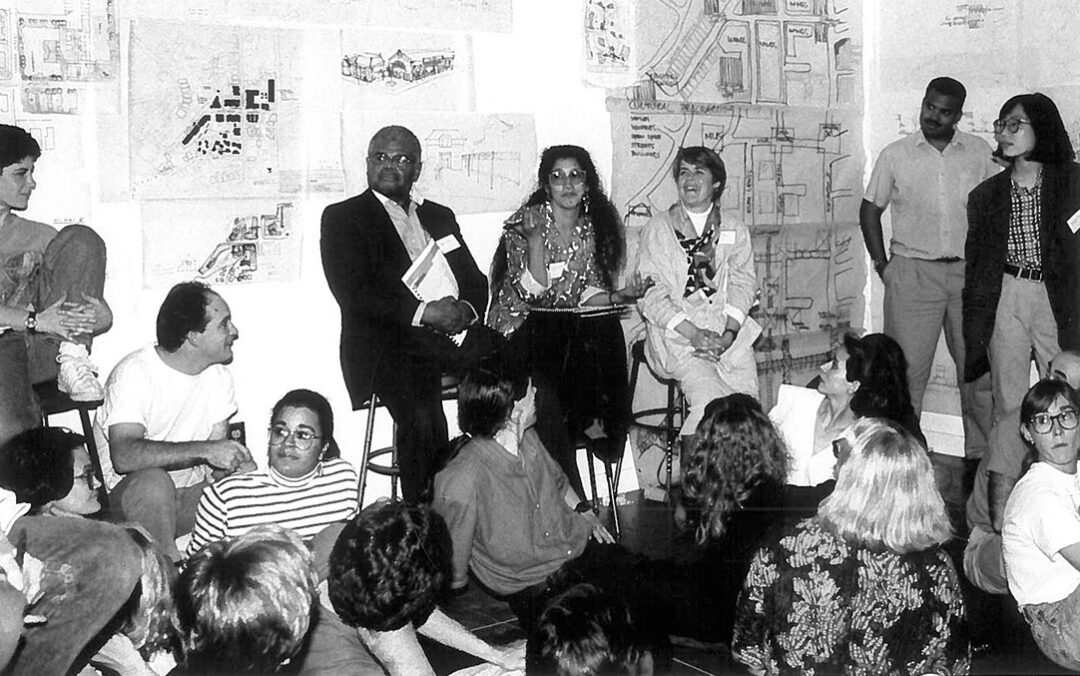
In 1991, Gail, and several members of the Boston Society of Architects’ Women in Design Group put together a weekend conference and design charrette titled “Our Lives Have Changed, Our Housing Hasn’t.”
The conference focused on the disconnect between evolving American household structures:
- the rise of single-parent households, dual-income families, and non-familial households
- a housing stock that remained largely designed for the traditional nuclear family of the 1950s.
The lifestyle and economic needs of Bostonians had shifted drastically, but building codes and architectural design still prioritized large, single-family homes that no longer met the needs of many people seeking housing. By 1990, housing production in the Boston metro area had significantly slowed after a boom in the late 1980s, and the area faced an aging housing stock with roughly 60% of units built before 1940.
Boston was undergoing multiple demographic shifts. Reversing the trend of “white flight’ to the suburbs, the urban core was experiencing gentrification from university and college students and people newly interested in living in the city, as well as rapid diversification of the population, giving rise to racial tensions around housing in echoes of the controversial school desegregation through busing of the 1970s.
Even then, Boston had a significant stock of public housing, but demand was larger than supply. Low-income residents were pushed further out of the city and higher income people were moving in.
“Unfortunately, and frustrating to me, so many of these issues we were trying to resolve have not been solved but many have been exacerbated in the last 30 years,” Gail said.
Attempts were made to modernize public housing, starting with the former Columbia Point public housing in Dorchester, now Harbor Point. This was the first time in the country that a public-private partnership redeveloped public housing, Gail said.
The “Our Lives Have Changed, Our Housing Hasn’t” charrette was two days long, and between 60 and 80 people attended, with 150 people participating in the conference. The kickoff speaker was Kip Tiernan, founder of Rosie’s Place.
“We had developers, nonprofit developers, architects, engineers, activists, and the focus of the charette was to try to make a point about our lives have changed, our housing hasn’t,” Gail said.
At this time, Gail was still working as an architect at Sunset Street Associates, but knew she was looking for something different. She eventually decided to work at Sunset Street half time for a few months while working on the charette and conference the other half of her time.
Stay tuned for Part 2, where we will delve into Gail’s connection to the Dudley Street Neighborhood Initiative and what became the Dudley’s Young Architects and Planners project.